
From http://www.sbig.com/sbwhtmls/st10.htm
Key points from last time:
There are two basic kinds of telescopes: refractors and reflectors.
Refractors form an image of an object by focusing the light using a lens.
Reflectors form an image of an object by reflecting the light off of mirrors and into an eyepiece or electronic detector.
The following web page, from Nick Strobel's Astronomy Notes (www.astronomynotes.com), gives a good description of how these two kinds of telescopes work.
Advantages of reflectors over refractors:
Data are recorded using photographic (rarely) or electronic devices (almost always) and analyzed back at the office. Electronic detectors are known as charge-coupled devices (CCDs), and they are the same thing that is in your digital camera or camcorder. This one is 15 x 10 mm in size.
From http://www.sbig.com/sbwhtmls/st10.htm
Infrared astronomical observations must be conducted at a site that is high and dry. Water vapor in the Earth's atmosphere absorbs a lot of infrared radiation, so infrared telescopes must be above as much of the water vapor as possible. [This is why you will never find an infrared telescope at sea level.] Two of the telescopes on Mauna Kea (below) are designed specficially for infrared observations.

From http://www.ifa.hawaii.edu/mko/
This is a reminder of how far into the Earth's atmosphere radiation at different wavelengths can penetrate before being absorbed.

From http://cossc.gsfc.nasa.gov/images/epo/gallery/spect/index.html
Spectroscopy is where an object's spectrum instead of an image is collected. After the light from the object is focused by the telescope, it passes through a prism, which disperses the light and breaks it up into its component colors.


This is a spectrograph used with the 3.5-meter telescope at Apache Point Observatory in Sunspot, NM. Note that it is not a small instrument!
Adaptive Optics is a fairly new technology that is used to remove distortions in an image caused by the turbulence in the Earth's atmosphere. This is done by rapidly sensing the signal from an object, calculating what effect the atmosphere is having on the image, and "undoing" it by slightly changing the shape of a flexible mirror to compensate for the atmospheric motion. The results are amazing!


Both images taken from http://cfao.ucolick.org/ (this is a really good web site if you're interested in learning more about adaptive optics)
Space Observatories are expensive, but they are necessary to study radiation at wavelengths that cannot penetrate the Earth's atmosphere (what wavelengths are those??). They also provide the added benefit of being above the Earth's atmosphere, which causes blurring of images due to atmospheric turbulence (see section above on Adaptive Optics). Here are a few examples of space observatories (4 NASA Great Observatories):

Hubble Space Telescope (1990-present)
UV/visible/near-IR
Taken from http://hubblesite.org/gallery/showcase/telescope/index.shtml

Compton Gamma Ray Observatory (1991-2000)
Gamma Ray
Taken from http://cossc.gsfc.nasa.gov/index.html
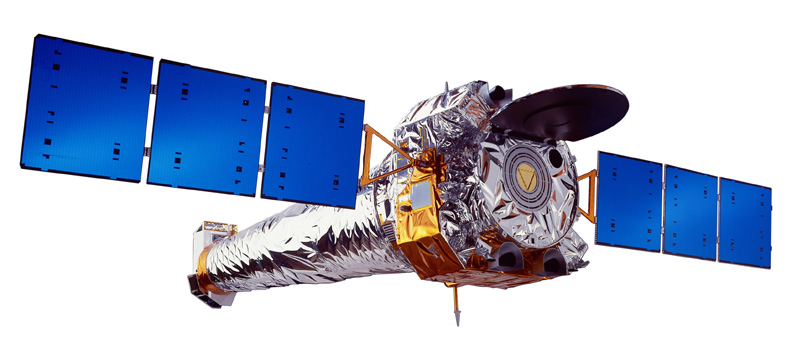
Chandra X-Ray Observatory (1999-present)
X-Ray
Taken from http://chandra.harvard.edu/resources/illustrations/craftIllustrations.html

Space Infrared Telescope Facility (launched on August 25, 2003)
Infrared
Taken from http://sirtf.caltech.edu/picturegallery/index.shtml