

Isabel image from NASA, global warming image from EPA.
The atmospheric layers are shown here, along with a good description of the various layers here.
You should also be aware of the difference between weather and climate. Weather is the day-to-day circulation patterns that we see in our atmosphere. The atmosphere tries to distribute heat from warm areas to cooler areas. This causes winds, and the water cycle on Earth introduces clouds, rain, hurricanes, etc. Climate is long-term variations in the Earth's atmosphere (e.g. warming or cooling trends over decades or centuries). Climate changes are difficult to measure over short time scales, but can have more profound effects on life on Earth.
Isabel image from NASA, global warming image from EPA.
The current composition of the Earth's atmosphere is
78% Nitrogen (N2)
21% Oxygen (O2)
1% Argon (A)
trace amounts of carbon dioxide (CO2) and water vapor (H2O)
If the Earth were just a little bit warmer (and we believe that it was warmer in the past), then the oceans would evaporate (leading to more water vapor in the atmosphere), and sedimentary carbonate rocks would release a lot of carbon dioxide into the atmosphere. Thus, what we see now is not a good representation of what the Earth was like in the past.
The processes that have altered the Earth's atmosphere are
Early algae forms that developed several billion years ago were the first example of photosynthesis, where plants use carbon dioxide from the atmosphere and release oxygen as a waste product. Initially, this oxygen got used up right away in chemical reactions with rocks in the Earth's crust. Eventually, the plant life became more prevalent and increased the amount of oxygen in the atmosphere. The increase in oxygen led to the formation of the ozone layer in the Earth's atmosphere (see above). Before the formation of the ozone layer, land was too dangerous for life to exist happily due to the Sun's harmful UV radiation (UV-B).
In parallel to the increase in oxygen, there was a decrease in available carbon on the Earth's surface due to erosion. Thus, overall there was a decrease in the atmospheric carbon dioxide. The development of life on Earth is what sets our atmosphere apart from that of Venus, our next-door neighbor in the solar system. The atmosphere of Venus is very thick, and is composed mostly of CO2.
The amount of carbon dioxide in the Earth's atmosphere is important because it regulates the Earth's temperature through a process known as the greenhouse effect. The greenhouse effect is rise of Earth's surface temperature because certain "greenhouse gases" (e.g. CO2 or water vapor) trap energy from the Sun. Sunlight reaches the Earth. Some of it gets reflected by the Earth's clouds and atmosphere, and some of it reaches the surface. The surface absorbs the sunlight, and re-emits infrared radiation. Some of that infrared radiation does not escape because the gases in the Earth's atmosphere absorb it, and then re-emit it in all directions. The result is that the surface temperature on Earth is about 25 degrees warmer than it would be if we had no atmosphere. [Car analogy, humidity analogy]
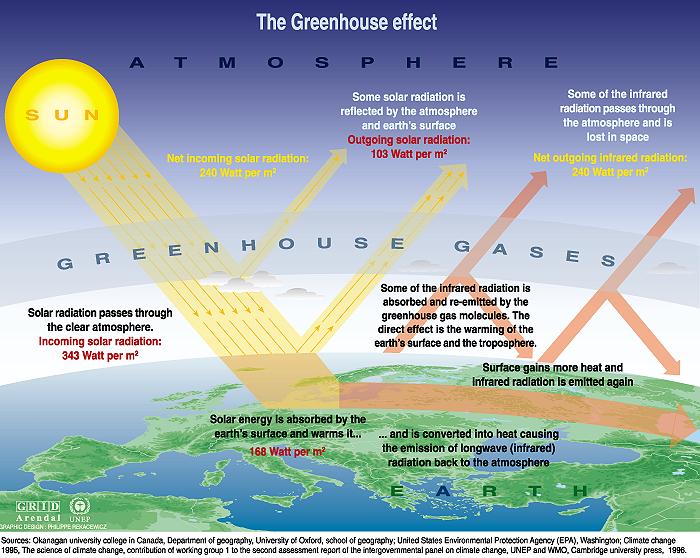
From http://www.grida.no/climate/vital/03.htm
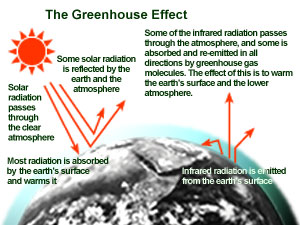
From http://yosemite.epa.gov/oar/globalwarming.nsf/content/climate.html
The greenhouse effect alone is not a bad thing. If it did not exist, the Earth would be totally frozen and we wouldn't be here. The bad part is that the heating due to the greenhouse effect is increasing. This is known as global warming. Global warming is due to two effects:
1) industrial activity (burning of fossil fuels) releases additional CO2 into the Earth's atmosphere
2) deforestation (chopping down the tropical rain forests) reduces the number of trees that can use this CO2 for energy and release O2 back into the atmosphere. Can you think of any recent trends on Earth that point towards global warming?
The Moon is the only other solar system body that has been visited by human beings. Between 1968-1972, 9 Apollo missions went to the moon, landing 12 astronauts on its surface. Much of what we know about the Moon today is due to the information returned from the Apollo missions (samples, seismometers, imaging) and more recent missions to the Moon (Clementine, Lunar Prospector).
General properties of the Moon:
When we look at a full moon in our night sky, we see splotchy regions of darker material along with the lighter grey material that seems to be more prevalent. At closer look (with a telescope), we see that the darker regions are less heavily cratered than the lighter regions. There is a large number of craters of varying sizes on the Moon.
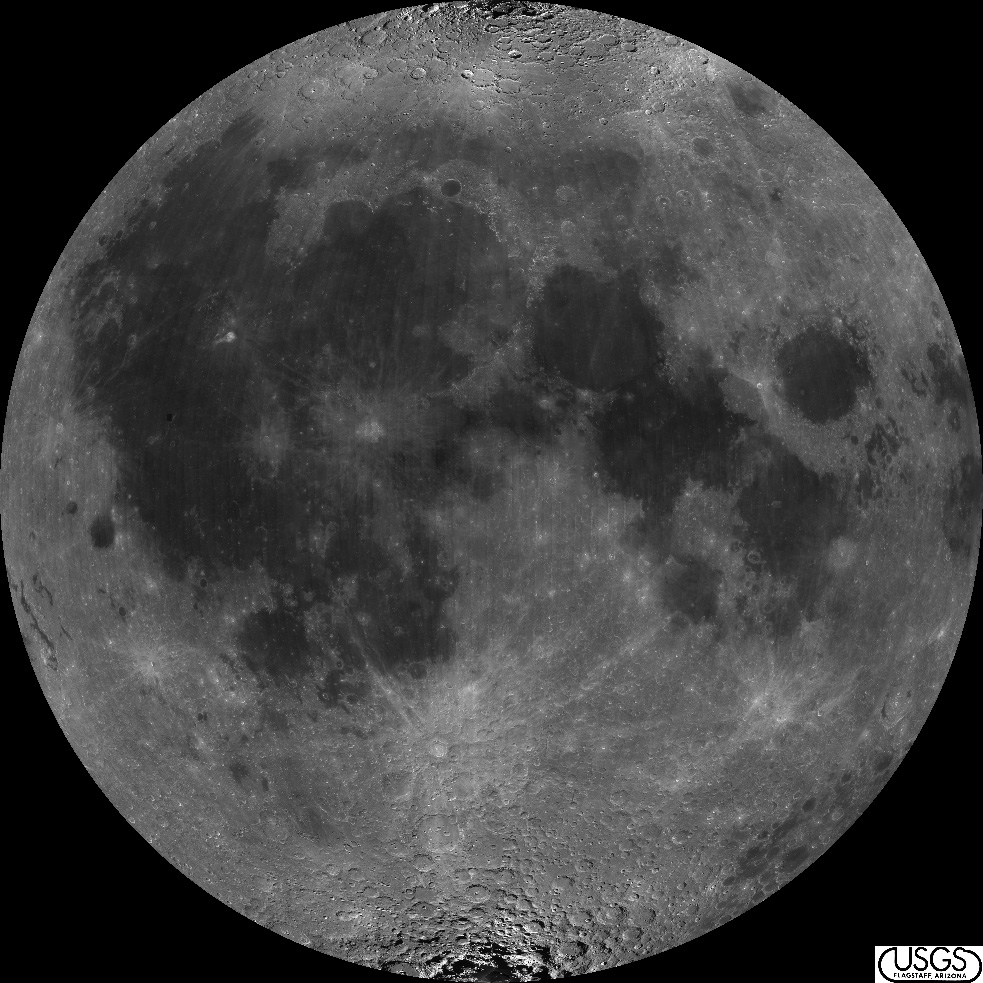
From http://www.nineplanets.org/pxmoon.html
The ligher, heavily cratered regions are known as the highlands. This area is composed of low-density rock, which cooled very early in the history of the Moon's formation.
The darker areas are called maria, which is plural of mare, which is the Latin word for "sea." The maria are composed of basalt rocks, similar to the Earth's crust or the lava rock found on Earth. The maria are volcanic plains, or large areas that were filled in with flowing lava. Some volcanic activity occured early in the Moon's history, creating the maria, but then ceased. The Moon is considered to be geologically "dead" at the present time.