
Average score was 86.9
Overall I was pleased with your performance on Exam 1! There were a few questions that quite a few people had trouble with, so I will go over those in class and answer any of your questions at that time.
Average score was 86.9
There are two ways of determining ages of planetary surfaces. The first is crater counting, and the second is radioactive dating.
Crater counting provides a means for measuring a relative age of a surface - giving a rough idea of whether a surface is "young" or "old," but not providing an absolute age in years. Crater counting measures how long a surface has been exposed. More craters = more time exposed. If a surface lacks craters, then that could mean one of two things:
Radioactive dating measures relative amounts of radioactive material in rocks, and provides an actual age for the material ("this rock is 3.3 billion years old").
Some chemical elements (e.g. Uranium) are not stable. Rather, their nuclei spontaneously split apart (decay) into smaller nuclei. When this happens, energy (gamma rays) or electrons are given off. The result is that some portion of the original element (e.g. Uranium), the parent element decays into another element (e.g. Lead), the daughter element.
The half-life is the amount of time it takes for half of a sample to decay from the parent into the daughter element. For example, the half-life for uranium is 4.47 billion years. Thus, if I have a rock that I know started out as all uranium, and when I measure its composition in the lab I find that it is composed of 50% uranium and 50% lead, then one half-life has elapsed since the time the rock formed, or 4.47 billion years have gone by.
What are some advantages/disadvantages of each method?
Early in the history of the solar system, there was a period known the "heavy bombardment period" when there was a lot more leftover debris (from planets that did not form) in the inner solar system. This "left-over" material is the source for most of the impact craters that we see on the Moon today. Nearly all of the planetary surfaces of the inner solar system got bombarded with this material; the Earth has not preserved the record as well as the Moon due to atmospheric and geologic processes.
Here are some craters on Earth:

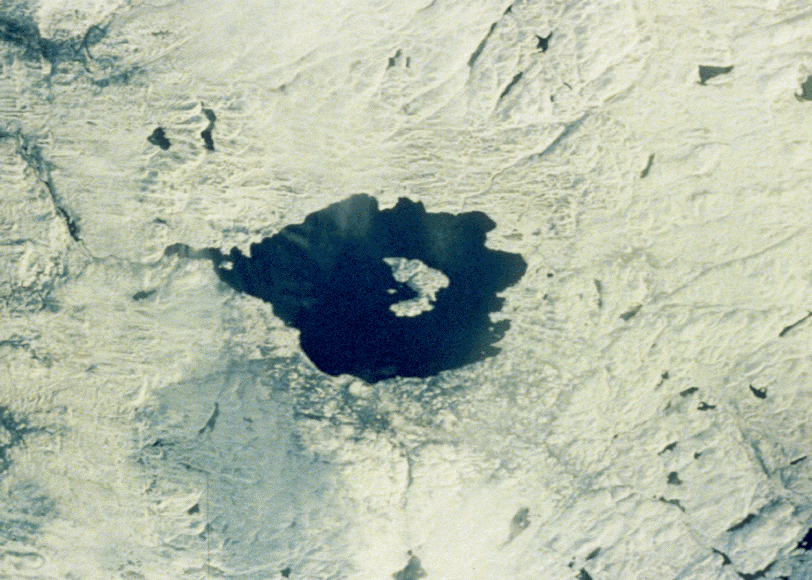

Note the change in the appearance of the three craters shown above as they get older. The first one is the youngest, and the last one is the oldest.
When an impactor strikes a planetary surface, several things happen:
Here is a good description of craters. Another thing that crater studies can be used for is the study of the sizes of impactors in the early solar system. If we know the gravity of the planet and the size of the crater, we can figure out the size of the impactor. That tells us something about what the conditions were like in the early solar system.
We have not yet discussed the formation of the solar system, which we will address later in the semester. However, ideas about how the Moon form are quite different, and are a current subject of research.
There have been three basic ideas about how the Moon formed:
There are problems with all of the above hypotheses:
The Giant Impact hypothesis is currently the most favored idea about how the Moon formed. In this theory, a large impactor (Mars-sized) hit the Earth shortly after it formed. The impact would have ripped away a large portion of the Earth's material (mostly mantle), sending it into space. Some of that material would have ended up in orbit as a ring around the Earth, which then cooled and coalesced into the Moon.
Reasons this hypothesis is favored:
Here are some simulations that show how this might have happened.
This web page contains a lot of "artist's renditions" of what the Moon formation process would have looked like.