Just to revisit the idea of radioactive dating....
Radioactive dating measures relative amounts of radioactive material in rocks, and provides an actual age for the material ("this rock is 3.3 billion years old").
Some chemical elements (e.g. Uranium) are not stable. Rather, their nuclei spontaneously split apart (decay) into smaller nuclei. When this happens, energy (gamma rays) or electrons are given off. The result is that some portion of the original element (e.g. Uranium), the parent element decays into another element (e.g. Lead), the daughter element.
Radioactive decay is sort of like making popcorn: you never know when an individual kernel will pop. However, once it pops, it is irreversibly changed. Over some period of time, most of the corn will have popped. For radioactive decay, one cannot predict exactly when a particular atom (of the parent element) will decay into the daughter product. There is a characteristic rate for the decay, and this is called the half-life.
The half-life is the amount of time it takes for half of a sample to decay from the parent into the daughter element.
Each radioactive element has its own unique half-life:
By comparing the relative amounts of parent and daughter elements in a rock, we can determine the number of half-lives that have elapsed, and therefore the age of the rock.
Here is a Java applet that shows a computer simulation of radioactive decay.
Earth rocks: All have been processed by geologic activity (volcanoes, plate tectonics). The oldest rocks on Earth have been measured to be approx. 4 billion years old. This is likely a lower limit to the age of the solar system.
Moon rocks: The oldest samples from the Moon have been measured to be approx. 4.4 billion years old. However, even the Moon's surface was melted and resolidified during its early history (formation of the maria). So the Moon's surface is not totally old either.
Meteorites: The oldest meteorites (rocks that have fallen to Earth's surface from elsewhere in the solar system) have been measured to be approx. 4.6 billion years old. This is likely a rock that has been unchanged since the time of the solar system formation, thus it represents our closest estimate to the true age of the solar system.
Facts about Mercury (that you should eventually know!):
Mercury lacks a thick atmosphere like that of the Earth, so in that sense it is more like the Moon. It is very close to the Sun, so its dayside temperatures are very high (~ 700 K). However, its nightside temperatures are very cold (~100 K)! Mercury has the largest temperature swings in the solar system.
Mercury's high density implies that it has a large amount of metal in its core. In fact, Mercury seems to lack most of the lighter rocky material, which is opposite of the Moon. Mercury also possesses a weak magnetic field, which implies that some of the metal in Mercury's core is still molten.
Much of what we know about Mercury's surface was learned when the Mariner 10 spacecraft visited the planet in 1974, and sent back photographs of one hemisphere of Mercury. These are the most prominent features:
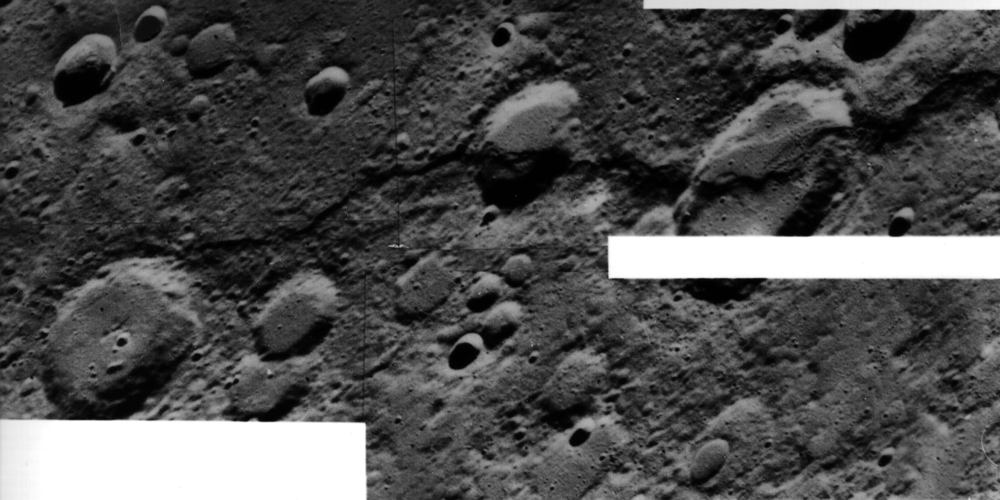
The origin of the scarps is thought to be a uniform cooling process of the planet, which caused Mercury to shrink slightly. This would wrinkle the crust, in the same way that the skin of an apple becomes wrinkled as the apple "ages."
Mercury has not been visited by a spacecraft since 1974. It is also difficult to observe from Earth because it is so close to the Sun. There are 2 new missions to Mercury that are scheduled: NASA's MESSENGER (launch in Spring 2004), and ESA's BepiColombo (launch in 2012).