
This figure shows the relative sizes of the planets to scale. You can see how much larger the giant planets are than everything else in our solar system except the Sun, which is shown on the left side of the figure.
We now turn to the largest, more distant members of our solar system. The four largest planets (Jupiter, Saturn, Uranus, and Neptune) are also referred to as
This figure shows the relative sizes of the planets to scale. You can see how much larger the giant planets are than everything else in our solar system except the Sun, which is shown on the left side of the figure.
HOW DO WE KNOW WHAT WE KNOW ABOUT THE GIANT PLANETS?
Ground-based observations were and are still used to learn new information about the giant planets. They were even used to discover Uranus and Neptune, which are smaller and more distant than Jupiter and Saturn. Things we can learn today using ground-based observations include information about the planets' chemical composition (spectroscopy) and clouds/winds/weather/atmosphere.
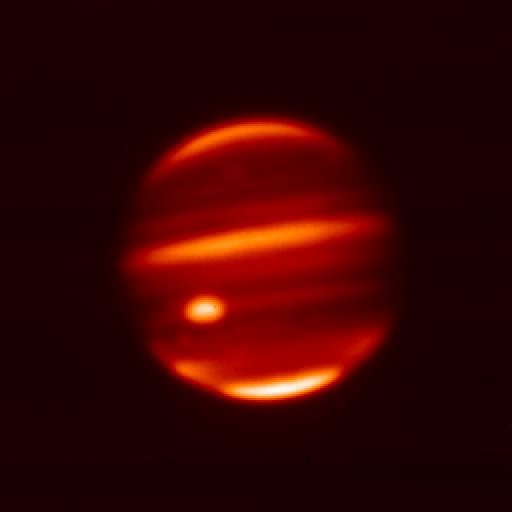
This near-infrared image of Jupiter was taken with the Apache Point Observatory 3.5 meter telescope in Sunspot, NM, in Feb. 1995.
Certain wavelengths (such as what ???) require observations to be made above the Earth's atmosphere; for that we can use the Hubble Space Telescope.
Finally, spacecraft visits to the outer planets have provided us with a wealth of unique information, and have raised as many questions as they answered. The following spacecraft have visited the outer planets:

The Voyager 1 and 2 spacecraft are now much farther away from Earth and the Sun than Pluto is and they are approaching the boundary region - the heliopause - where the Sun's dominance of the environment ends and interstellar space begins. Voyager 1, more than twice as distant as Pluto, is farther from Earth than any other human-made object and is speeding outward at more than 17 kilometers per second (38,000 miles per hour). From http://voyager.jpl.nasa.gov/mission/mission.html.
Judging by the relatively small number of spacecraft we have sent to the outer solar system, you can probably surmise that it is a much more difficult undertaking. Why is it so much harder?
It takes longer to get there since the distances are so great, and we rely on the gravity assist of some inner planets to get there relatively cheaply. [Here is a web site that explains how this was done for the Cassini spacecraft, which is on its way to Saturn right now.]
The spacecraft have to be a lot "smarter" or autonomous, since it takes to long to relay repair commands in real time.
The spacecraft are required to bring their own power source, since the radiation they receive from the Sun becomes weaker as distance from the Sun increases (remember the 1/r2 dependence!).
The radiation environment near the large planets can be extremely hazardous, and can damage electronic equipment.
Table 10.3 in your book is an important one, because it provides you with an overview of how the giant planets are similar to (or different from) one another. However, we should start by comparing how a representative of these large planets (Jupiter) differs from a terrestrial planet (Earth), which we are much more familiar with.
| Property | Earth | Jupiter |
| Distance from Sun (AU) | 1 | 5.2 |
| Flux received from Sun | 1 | 1/25 |
| Orbital Period (Earth yrs) | 1 | 12 |
| Diameter | 1 | 11.2 |
| Mass | 1 | 318 |
| Density (g/cm3) | 5.5 | 1.3 (S: 0.7, U: 1.3, N: 1.6) |
| Rotation (hrs) | 24 | 10 |
The giant planets are all composed primarily of the lightest elements in the universe: hydrogen and helium. Thus, any heavier elements (like Carbon, Nitrogen, or Oxygen) tended to combine with hydrogen to make things like CH4 (methane), NH3 (ammonia), and H2O (water). These molecules are found in trace amounts (i.e. with an abundance of less than 1%) in the giant planets.
The giant planets experience seasonal changes just like some of the terrestrial planets, and again, it is dependent on the tilt of their spin axes. Jupiter's tilt is 3 degrees, so it experiences few seasonal effects. Saturn and Neptune have tilts of 27 and 29 degrees, so they experience seasons (very slowly; one Saturn year is 30 Earth years, and one Neptune year is 165 Earth years!). Uranus orbits on its side, with a tilt of 98 degrees. We think this tilt may be due to a large impact early in its formation history, but we still aren't sure. The seasons on Uranus are each 21 Earth years long, and sometimes a polar region can be in direct sunlight for 21 years.

We can learn something about the interior structure of the giant planets by studying a spacecraft's response to the planet's gravitational field. A large sphere with a dense core will exert a different gravitational pull on a spacecraft than a sphere with a uniform mass distribution. Based on results from previous spacecraft visits to the outer planets, we believe that all four of the gas giants have a small rocky core at their centers, surrounded by a layer of icy material.
The interiors of Jupiter and Saturn are so dense that the hydrogen gas gets compressed to very high pressures, eventually so that the hydrogen behaves like a metal. This material is very unusual and is very difficult to reproduce in a laboratory on Earth because it is difficult to achieve such high pressures.

Image courtesy of Tristan Guillot.