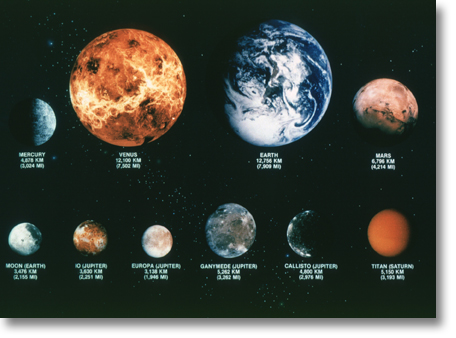
Image courtesy of NASA/JPL
Titan is the second largest moon in our solar system (smaller only than Jupiter's Ganymede), and it is the only moon in the solar system with a substantial atmosphere. Its atmosphere is roughly 1.5 times thicker that of the Earth's, and it is also made of Nitrogen, like the Earth's. It is a lot colder, though, so rather than having a water cycle, Titan has a methane cycle. This means that there may be solid, liquid, and gaseous methane all existing on Titan. Titan's atmosphere contains many complex organic hydrocarbons, which the Earth also contains. We believe that these hydrocarbons were the building blocks for life and the formation of DNA (on Earth), thus their presence on Titan is extremely tantalizing.
Image courtesy of NASA/JPL
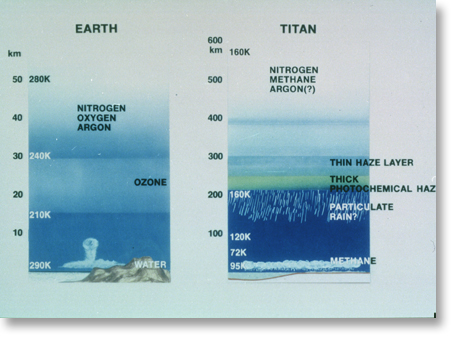
Image courtesy of NASA/JPL
Titan was first explored with the Voyager spacecraft in 1980 and 1981, but the imaging cameras on board the spacecraft could not penetrate through Titan's thick haze (like the smog in Los Angeles, but much thicker!). Recent infrared images taken with the Hubble Space Telescope have been able to see through the haze to Titan's surface, and we see bright and dark continent-sized areas. Are these continents? Mountains? Seas? Oceans? We do not know yet.
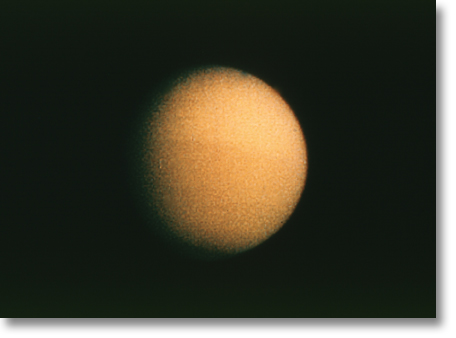
Image from Voyager spacecraft, courtesy of NASA/JPL
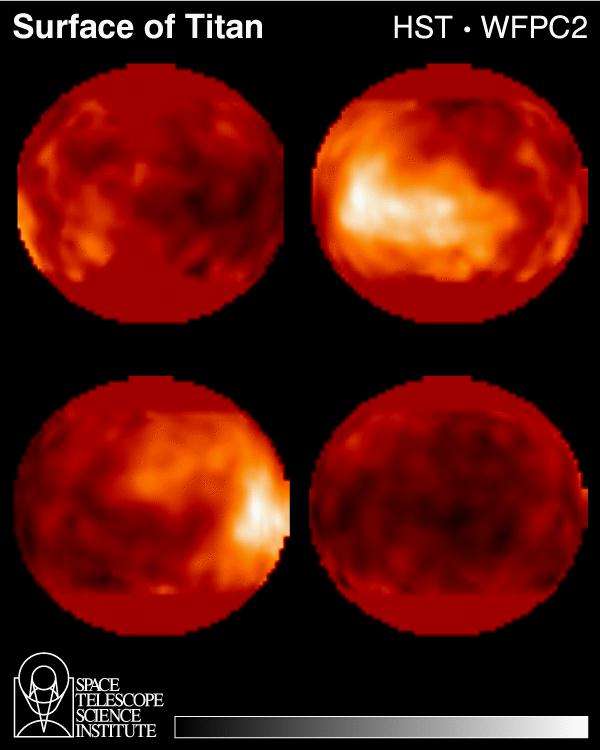
Image from Hubble Space Telescope
The Cassini spacecraft will arrive at Saturn in July 2004, and will drop a probe into Titan's atmosphere at the end of 2004. With the probe information as well as the orbiter's radar system, we will finally have an opportunity to see what is below Titan's clouds and hazes.
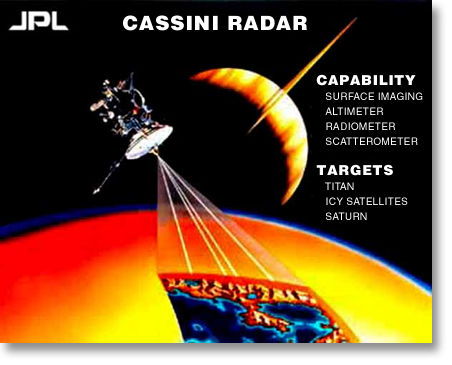
Image courtesy of NASA/JPL
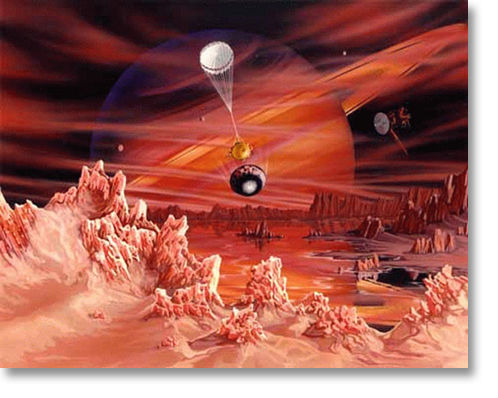
Image courtesy of NASA/JPL
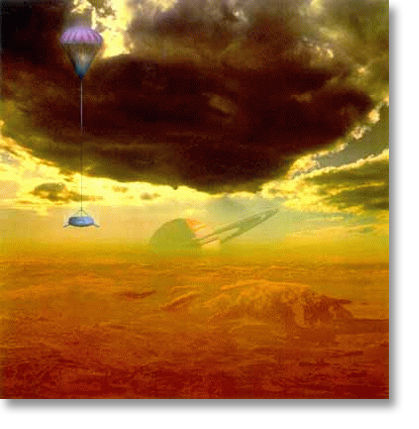
Image courtesy of NASA/JPL
Triton is Neptune's only large moon, and it is an excellent example of the "ice geology" that we believe occurs in the outer solar system, where ice takes the place of rock in the role in geology.
Triton orbits Neptune in the retrograde, or backwards, direction. This suggests that it did not form near Neptune at the time of the solar system formation. Rather, it probably formed elsewhere, beyond the orbit of Neptune, and was captured by Neptune's gravity as it passed nearby. Like Uranus, Triton is also orbiting on its side, with the north and south poles alternating in direct sunlight. When the Voyager 2 spacecraft went by in 1989, Triton's south pole was in sunlight.

Image courtesy of NASA/JPL
Triton's surface contains very few impact craters, indicating that its surface is very young. It has evidence of a wrinkled surface (the so-called "canteloupe terrain"), indicating perhaps evidence of past tectonic activity. It also has refreshed surface areas like the lunar maria, indicating possible ice/slush flooding in the past. Finally, it has dark streaked areas that are thought to be due to eruptive geysers, which spew liquid nitrogen and methane from below Triton's surface. These are known as ice volcanoes.

Image courtesy of NASA/JPL

Image courtesy of NASA/JPL

Image courtesy of NASA/JPL