Image courtesy of the Space Telescope Science Institute and NASA.
Remember, any theory that explains how planetary systems form MUST be able to explain the patterns we see in our own solar system. These patterns can be summarized in four categories:
| Terrestrial Planets | Jovian Planets |
| smaller mass, size | larger mass, size |
| rock, metal composition | light gases, hydrogen compounds |
| solid | no surface |
| closer to Sun (and closer together) | farther from Sun (and spaced farther apart) |
| warmer | cooler |
| few moons, no rings | many moons, rings |
| Asteroids | Comets |
| small rocky bodies | small icy bodies |
| mostly between orbits of Mars and Jupiter | two populations: Kuiper Belt and Oort Cloud |
| orbit in same direction as planets (CCW) | KB: orbit in same direction as planets |
| some have fairly elliptical orbits | OC: random orbits, not in plane of planets |
| probably 100,000 or more | millions or billions of them |
The Nebular Theory of Solar System Formation states that our entire solar system formed out of a nebula, or gas cloud. This cloud underwent:
These steps do explain some of what we see. The basic orbital motion of the planets (counter-clockwise as seen from above the N. Pole) derives from the spinning nebula. The fact that nearly all of the planetary orbits lie in a plane, and that nearly all moons and rings orbit their planets near the equators, can be explained by the flattening. It is easy to see how a flat, rotating disk of material can give rise to objects that all move in the same plane.
Once the solar nebula collapsed into a disk and the Sun "turned on," there was still a disk of dust and gas around it. How did we go from this disk of material to the current state of the solar system that we see today?
The solar nebula had a fairly uniform composition of 98% hydrogen and helium, 2% "other stuff." How did the planets end up with such different compositions? This happened through the process of condensation, which is the formation of a solid or liquid from a gas (think of water condensing on the outside of your cold drink on a summer day). The critical point here is that different materials condense at different temperatures.
Near the Sun, T ~ 1500 K. The only materials that could condense there must have high melting points. These are the metals (iron, nickel, aluminum). Farther out from the Sun, the temperatures were slightly cooler: silicates (rock) could condense. In the outer region of the solar nebula, temperatures were much colder: water, methane, and ammonia ices could condense. [The light gases like hydrogen and helium never condensed, so they stayed in the gaseous form.]
The temperature differences between the inner and outer solar nebula determined what condensates were available for planet formation (as the building blocks, or "seeds").
There are four main processes at work for planet formation:
Here is a web page with some visualizations of the steps in planet formation described above.
Some of the leftover material in the solar system became comets and asteroids. They probably once had circular orbits, but the strong gravity of the giant planets (especially Jupiter) may have perturbed their orbits and caused them to end up more random.
Immediately following the planet formation, there was a period known as early bombardment. The left-over planetesimals collided with other bodies in the early solar system. The solar system formed about 4.6 billion years ago, and the early bombardment period was about the first few hundred million years. This resulted in a large number of impact craters on the solid bodies. Moon and Mercury preserved that period in history with their old surfaces. Venus, Earth, and Mars have undergone more erosion, thus there is less of a record of the early bombardment on those surfaces. These impactors also may have delivered low-density materials (such as WATER) to the inner solar system, resulting in our large abundance of water on Earth today. Jupiter may have played a role in gravitationally "flinging" the comets towards the inner solar system.
The origin of the small, irregular moons in the solar system is likely gravitational capture. A planet's gravity can be strong enough to capture nearby planetesimals. This is more of a random process, so the orbits of those captured moons are more likely to be irregular since they didn't form with the planet itself.
The concept of impacts is used to explain a lot of the exceptions seen in the solar system today. Impacts can explain:
If all of the above information is true, would you expect most (or many) stars to have planetary systems?
Yes, but they are difficult to detect. However, there are two pieces of observational evidence that lead us to believe that we are on the right track to understanding planet formation.
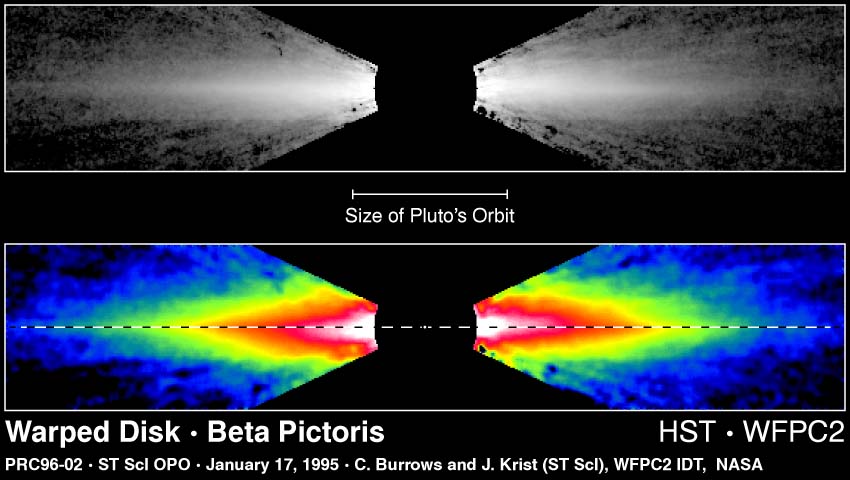
It is easier to detect the dust disks around newly formed stars than to detect fully formed planets around stars. This is because the sum of all of the individual dust particles making up the disks emits a lot of infrared radiation, whereas the planets individually do not emit much radiation.
The first protoplanetary disk that was discovered is called Beta Pictoris. Hubble Space Telescope has been used a lot for these kinds of studies because of its superb resolution and infrared capabilities.
Image courtesy of the Space Telescope Science Institute and NASA.
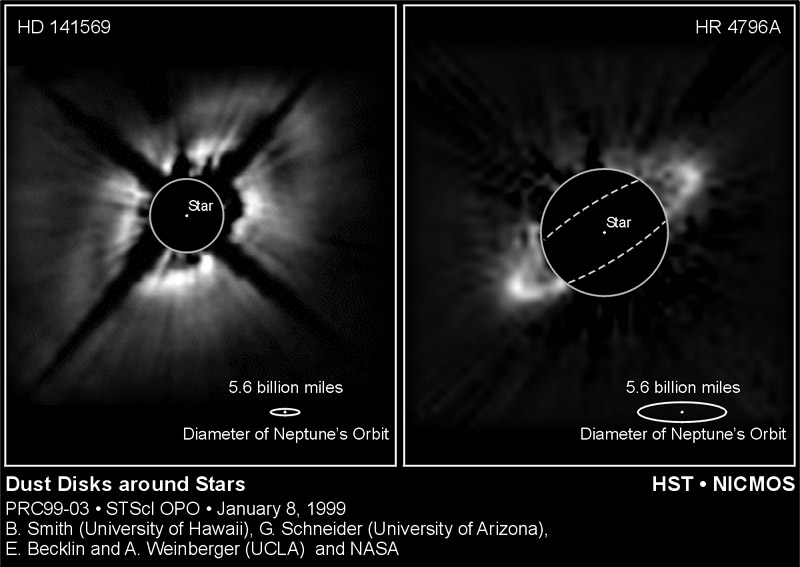
Image courtesy of the Space Telescope Science Institute and NASA.
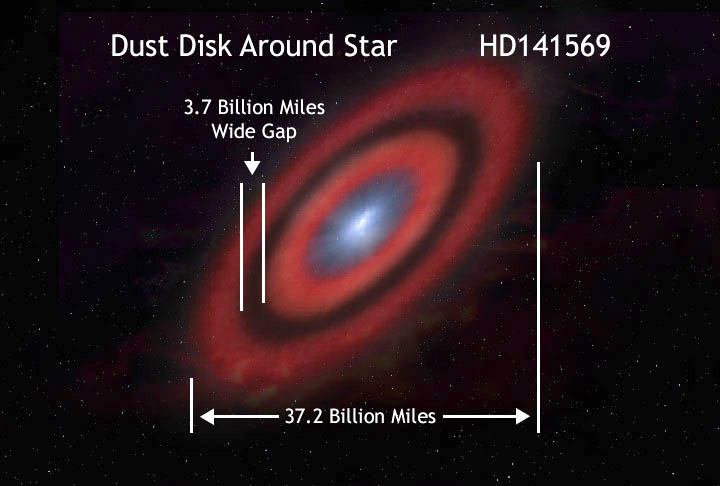
Image courtesy of the Space Telescope Science Institute and NASA.
The Orion Nebula is a spectacular region of star formation. Using Hubble Space Telescope, individual protoplanetary disks have been observed. The mosaic below was made from 15 separate views using HST, and reveals at least 153 protoplanetary disks, each with a very young central star surrounded by a gas and dust disk. Given how numerous these protoplanetary disks are in the Orion Nebula, it is likely that planetary system formation is a common occurrence.
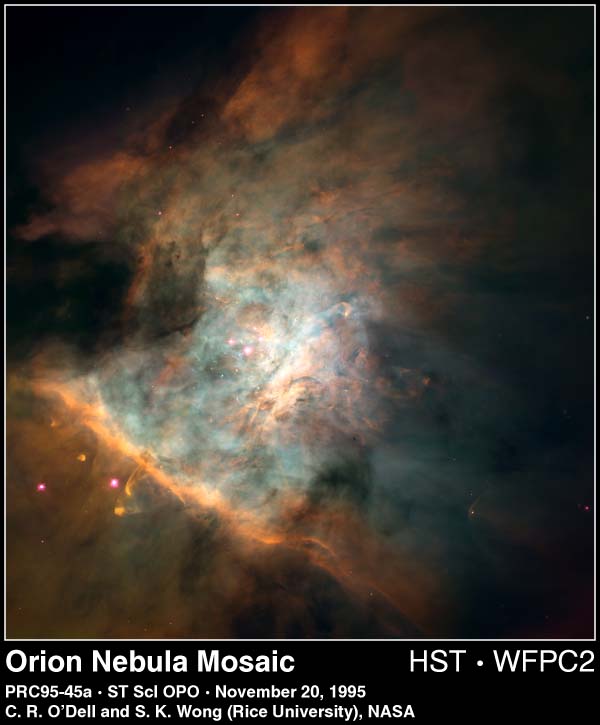
Image courtesy of the Space Telescope Science Institute and NASA.
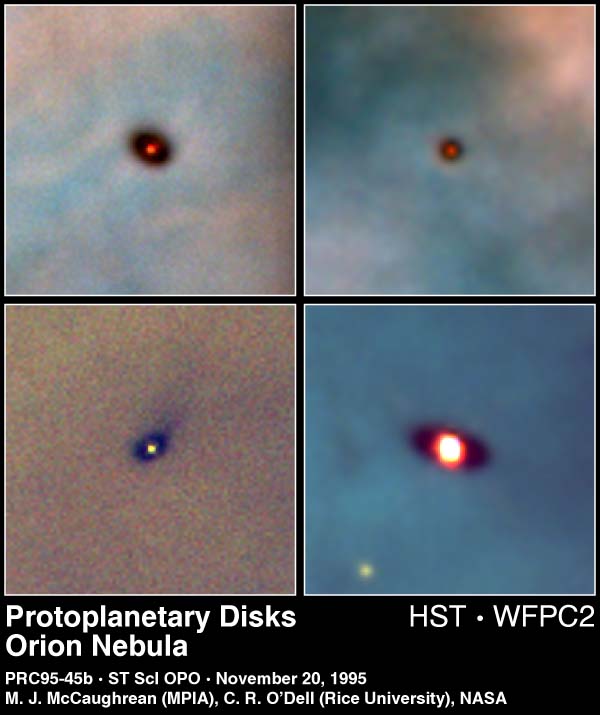
Image courtesy of the Space Telescope Science Institute and NASA. The size of the disks shown here are several times larger than the Sun-Pluto distance.
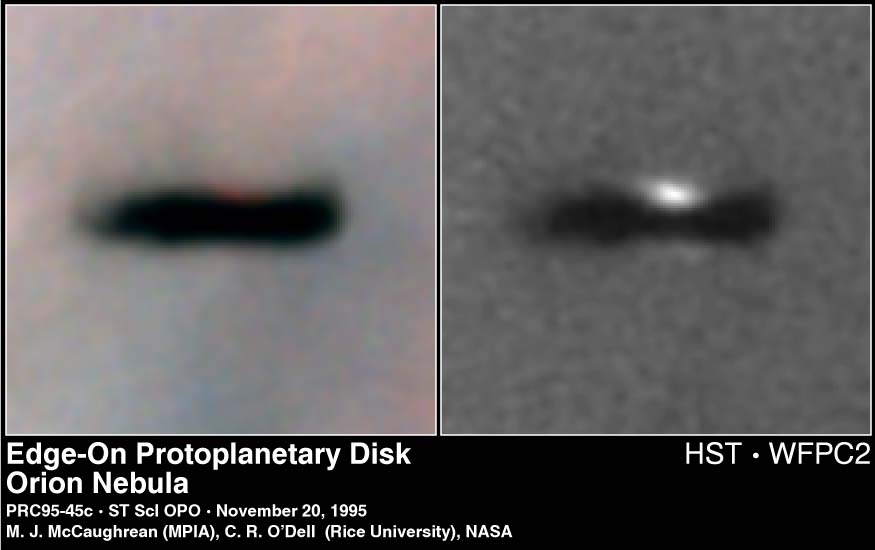
Image courtesy of the Space Telescope Science Institute and NASA.