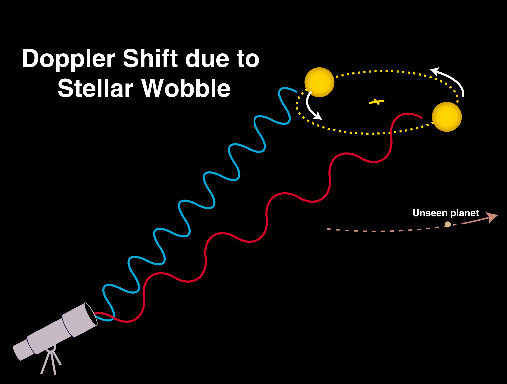
Image courtesy of the California and Carnegie Search for Extrasolar Planets web page (http://exoplanets.org/doppframe.html)
The solar nebula had a fairly uniform composition of 98% hydrogen and helium, 2% "other stuff." How did the planets end up with such different compositions? This happened through the process of condensation, which is the formation of a solid or liquid from a gas (think of water condensing on the outside of your cold drink on a summer day). The critical point here is that different materials condense at different temperatures.
Near the Sun, T ~ 1500 K. The only materials that could condense there must have high melting points. These are the metals (iron, nickel, aluminum). Farther out from the Sun, the temperatures were slightly cooler: silicates (rock) could condense. In the outer region of the solar nebula, temperatures were much colder: water, methane, and ammonia ices could condense. [The light gases like hydrogen and helium never condensed, so they stayed in the gaseous form.]
The temperature differences between the inner and outer solar nebula determined what condensates were available for planet formation (as the building blocks, or "seeds").
There are four main processes at work for planet formation:
Immediately following the planet formation, there was a period known as early bombardment. The left-over planetesimals collided with other bodies in the early solar system. The solar system formed about 4.6 billion years ago, and the early bombardment period was about the first few hundred million years. This resulted in a large number of impact craters on the solid bodies. Moon and Mercury preserved that period in history with their old surfaces. Venus, Earth, and Mars have undergone more erosion, thus there is less of a record of the early bombardment on those surfaces. These impactors also may have delivered low-density materials (such as WATER) to the inner solar system, resulting in our large abundance of water on Earth today. Jupiter may have played a role in gravitationally "flinging" the comets towards the inner solar system.
The concept of impacts is used to explain a lot of the exceptions seen in the solar system today. Impacts can explain:
If all of the above information is true, would you expect most (or many) stars to have planetary systems?
Yes, but they are difficult to detect. However, there are two pieces of observational evidence that lead us to believe that we are on the right track to understanding planet formation.
Within the last decade, the study of planets orbiting stars other than our Sun has exploded. The first "extrasolar planet" was discovered in 1995, and as of Wednesday (4/28/04) there are 123 known planets around other stars. So far, all of these planets have been detected indirectly, meaning that astronomers observe their effects on their parent stars rather than detecting signals from the planets directly.
The detection of planets around other stars is difficult for several reasons.
There are 4 basic detection methods for finding extrasolar planets. They are very nicely described here in an interactive tutorial. Briefly, the four methods are:
Image courtesy of the California and Carnegie Search for Extrasolar Planets web page (http://exoplanets.org/doppframe.html)
All extrasolar planets except one have been discovered using the Doppler method; the exception was discovered using the transit method.
The first two discovery techniques described above are most sensitive to large planets that are fairly close to the parent star; this would induce the greatest "wobble" on the parent star, and therefore would be the easiest to detect. It may not be surprising, then, that most of the planets discovered so far fit this description.

Image courtesy of the California and Carnegie Search for Extrasolar Planets web page (http://exoplanets.org/massradiiframe.html)
Things to note about the above figure:
How do these discoveries compare to what we already have learned about planetary formation?
This field is very young (less than 10 years old), but there is a lot of activity and excitement about the discovery of planets in other solar systems. It is one of the most significant discoveries in modern astronomy; we have gone from being the only solar system we knew of to being one of over a hundred! Yet none of the new systems discovered resembles our own. Is this an observational effect (meaning we are not sensitive to small, Earth-like planets orbiting stars near 1 AU), or are we truly unique? Only time will tell. There are plans for several spacecraft missions in the next few decades to search for more planets - including terrestrial planets. You can read more about those missions here.