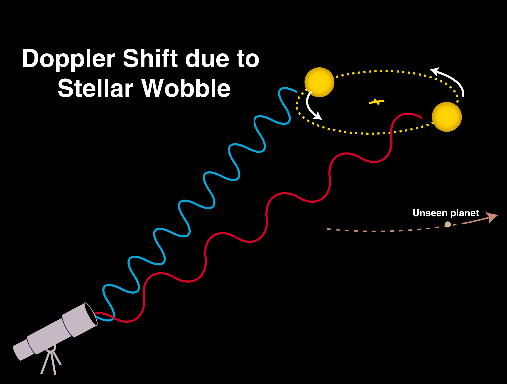
Image courtesy of the California and Carnegie Search for Extrasolar Planets web page (http://exoplanets.org/doppframe.html)
The Doppler method (or radial velocity method) is the most common technique used to find planets around other stars. It measures the slight redshift and blueshift of the star's spectrum due to the presence of the planet.
Image courtesy of the California and Carnegie Search for Extrasolar Planets web page (http://exoplanets.org/doppframe.html)
The discovery technique described above is most sensitive to large planets that are fairly close to the parent star; these induce the greatest "wobble" on the parent star, and therefore are be the easiest to detect. It may not be surprising, then, that most of the planets discovered so far fit this description.

Image courtesy of the California and Carnegie Search for Extrasolar Planets web page (http://exoplanets.org/massradiiframe.html)
The presence of the "hot Jupiters" is currently explained through migration. In other words, these giant planets probably formed far from their parent stars (as we believe they did in our own solar system), but were forced inwards due to gravitational interactions between other planets and/or leftover material in the protoplanetary disk.
Stay tuned for future developments; this is a very young field and new discoveries force us to rethink our theories about solar system formation and evolution on a regular basis.
The study of life in the universe is known as astrobiology. At the heart of this field of study is the question: Are we alone and/or unique? There are several different approaches that planetary scientists and biologists are using to address this question.




The likelihood of us detecting a signal from another intelligent species depends on a number of factors. In 1961, Frank Drake developed an equation that breaks down the difficult question of estimating the number of communicating civilization in the Galaxy into smaller, more manageable pieces. The Drake Equation goes like this:
N = Rstar x fp x fe x fl x fi x fc x L
where
N is the number of communicating civilizations that currently exists in the Galaxy
Rstar is the rate of star formation for Sun-like stars in our Galaxy (~ 10 stars per year)
fp is the fraction of these stars that have planets around them (0.1-1.0)
fe is the fraction of planetary systems that contain Earth-like planets
fl is the fraction of habitable planets that support life
fi is the fraction of planets with life that contain intelligent life
fc is the fraction of planets with intelligent life that are communicating with radio signals
L is the lifetime of a communicating species (in years)
There is no right answer, but let's plug in some guesses and see what we get:
N = 10 x 0.5 x 0.2 x 1.0 x 0.1 x 1 x 10,000 = 1000
Here is an on-line calculator for the Drake Equation; plug in some numbers and see what you get!
Again, there is no right or wrong answer - many of these parameters are quite subjective. One thing we CAN tell is that we are relative newcomers to this field, having the capability for interstellar communication for just a few decades. This is a big needle-in-a-haystack problem.