
Images from http://marsrovers.jpl.nasa.gov/gallery/images.html
Newton's Law of Gravitation is given by the following equation:
Fg = G [(M1 M2)/(R2)], where
G is called the gravitational constant
M1 is the mass of object 1
M2 is the mass of object 2
R is the distance between objects 1 and 2
The most important things to remember about gravity are the following:
We said previously that an object's Mass is the amount of material (atoms, molecules, etc.) it contains. Your mass does not change as you move from Earth to the Moon, for example (unless you ate 12 boxes of doughnuts along the way!).
An object's weight is a measure of the gravitational force felt by the object. Thus, it depends not only on your mass, but on the mass of the objeect you're standing on. If you travel to the Moon, you will weigh less there because the gravitational force it exerts on you is smaller (about one sixth of what you feel on Earth).
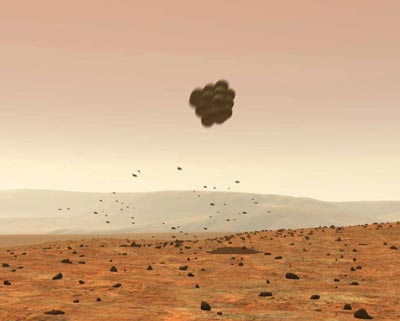
What about the Mars Rovers, that landed on Mars in a protective envelope of airbags? Is the gravity they are experiencing stronger or weaker than what they would have felt on the surface of the Earth? For comparison, the radius of Mars is approximately one-half the radius of the Earth, and the mass of Mars is roughly one-tenth the mass of the Earth.
Images from http://marsrovers.jpl.nasa.gov/gallery/images.html
If you throw a baseball, gravity will pull it back to Earth.
If you throw it even harder, it will go farther but still fall back to Earth.
If you could throw it with an extremely high velocity, it would travel completely around the Earth, always falling in the gravitational field but never reaching the Earth, which is curving away at the same rate that the baseball falls. That is, the baseball would have been put into orbit around the Earth.
Newton concluded that the orbit of the Moon was of exactly the same nature: the Moon continuously "fell" in its path around the Earth because of the acceleration due to gravity, thus producing its orbit.

Graphics courtesy of http://csep10.phys.utk.edu/astr161/lect/history/newtongrav.html.
One of the most common misconceptions about astronomy is the cause of the seasons on Earth. The seasons are NOT due to the fact that the Earth is closer to the Sun in June and farther from the Sun in January! In fact,
The seasons on Earth are due to the fact that the Earth's rotation axis is tilted 23 degrees relative to a line perpendicular to the plane of its orbit.

In June, the northern hemisphere of the Earth is "leaning towards" the Sun. At that time, the northern hemisphere receives more direct sunlight, and for a longer amount of time each day. In January, the northern hemisphere of the Earth is "leaning away" from the Sun (and the southern hemisphere is leaning towards the Sun).
Thought question: Mars' axial tilt is 25.2 degrees. Would you expect the seasons on Mars to be more or less extreme than they are on Earth? What about for Merucry, which has no axial tilt (0 degrees)?