
The seasons on Earth are due to the fact that the Earth's rotation axis is tilted 23 degrees relative to a line perpendicular to the plane of its orbit.
The seasons are NOT caused by Earth's varying distance to the Sun!
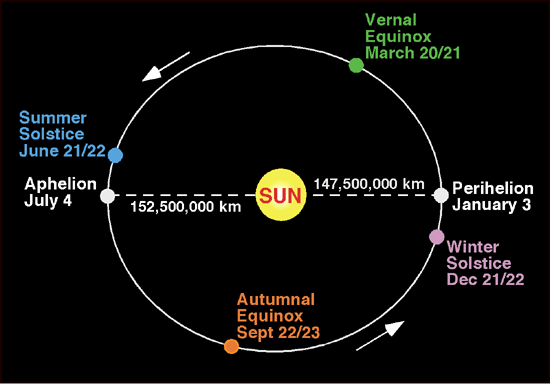
Image from http://www.physicalgeography.net/fundamentals/6h.html
In June, the northern hemisphere of the Earth is "leaning towards" the Sun. At that time, the northern hemisphere receives more direct sunlight, and for a longer amount of time each day. In January, the northern hemisphere of the Earth is "leaning away" from the Sun (and the southern hemisphere is leaning towards the Sun).

Image from http://www.physicalgeography.net/fundamentals/6h.html
Other planets will experience seasonal variations if they have significant axial tilts like the Earth. What changes on Earth due to the different seasons? Some examples include:
There are two effects that cause the surface temperature of a planet to be warmer during the summer (both are described in more detail here):

Image from http://www.physicalgeography.net/fundamentals/6h.html
In most places, there is a seasonal lag between the longest day of the year (summer solstice) and the hottest time of the year. For example, on Cape Cod, it is much warmer in July and August than it is in June. This is due to the fact that our planet has a lot of water on its surface. The water (and air in the atmosphere) reservoirs do not heat up instantaneously, and require extra time to absorb the energy from the Sun. Thus, the Earth gets warmer after it has had enough time to absorb the solar energy, which peaks at summer solstice.
We know by watching the Moon that it goes through phases - its apparent shape seems to change. In fact, by knowing the lunar phase, we can tell a) what it will look like, and b) what time it will be visible.
The lunar phases are:
Pictures of each lunar phase can be found here.
The phase we view the moon in is determined by its location (in its orbit) relative to the Earth and Sun.
Here is a java applet that shows the moon going through phases.
The Moon always has one hemisphere that is being illuminated by the Sun. The reason we see the moon go through phases is because due to the moon's orbit around the Sun, the illuminated hemisphere is not always directly facing towards Earth. This can be seen in the figure shown on the following web page.