The Moon always has one hemisphere that is being illuminated by the Sun. The reason we see the moon go through phases is because due to the moon's orbit around the Sun, the illuminated hemisphere is not always directly facing towards Earth. This can be seen in the figure shown on the following web page.
The phase we view the moon in is determined by its location (in its orbit) relative to the Earth and Sun. Here is a java applet that shows the moon going through phases.
This is a very cool web site from the Stardate program that tells you the lunar phase for any given day.
Suppose you were told that the Moon will be overhead at roughly 6 am tomorrow. How would you determine what phase it is in?
In reality, the Moon will be overhead at approximately 9 pm this evening. What phase will it be in?
Now that we understand the phases of the Moon, we can see why, at certain times, we can observe eclipses.
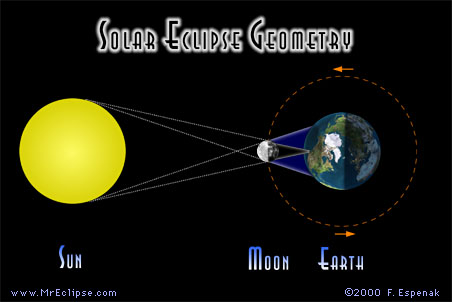
A solar eclipse occurs when the Moon passes between the Earth and the Sun, temporarily blocking out the Sun. The people on Earth who observe a solar eclipse are standing in the Moon's shadow.
Question: What lunar phase would it be if we are seeing a solar eclipse?
Solar eclipses are exciting and beautiful, and are scientifically important for studying the outer portion of the Sun, called the corona. Here are some solar eclipse pictures.